
Introduction
Jyutping is the standard way to romanize Cantonese — giving every sound a consistent spelling so you can read, write, and type Cantonese phonetically. It's built into the devices you already use: iPhone, Mac, and Android all support Jyutping input natively. On Windows, the free tool TypeDuck lets you type Jyutping on any PC.
The catch? Jyutping doesn't follow English pronunciation rules — it's closer to IPA (International Phonetic Alphabet) conventions. But don't worry. This guide will get you reading Jyutping confidently in just a few seconds.
Quick-Start Cheat Phrase

The fastest way to get a feel for Jyutping is through this shortcut phrase:
“The Bow Tie Sifu drives to Norway for Yum Cha.”
個煲呔師傅揸車去挪威飲茶
Each loan word is pronounced how an English speaker would expect:
Bow Tie (bou¹ taai³), SiFu (si¹ fu²), Norway (no₄ wai¹), Yum Cha (jam² caa₄)
| Jyutping | 粵 | Audio | English |
|---|---|---|---|
| go³ | 個 | the | |
| bou¹ taai³ | 煲呔 | Bow Tie | |
| si¹ fu² | 師傅 | Sifu | |
| zaa¹ ce¹ | 揸車 | drives | |
| heoi³ | 去 | to | |
| no₄ wai¹ | 挪威 | Norway | |
| jam² caa₄ | 飲茶 | Yum Cha |
The Basics
| Jyutping | 粵 | English | ||
|---|---|---|---|---|
| j | jam² caa₄ | 飲茶 | Yum Cha (loanword) | y |
| c | ch | |||
| a | uh | |||
| aa | ar | |||
| i | si¹ fu² | 師傅 | Sifu (loanword) | ee |
| u | oo | |||
| o | bo¹ | 波 | Ball (loanword) | or |
| e | me¹ | 咩 | "meh" a lamb's call (also means "what") | eh |
Combined Vowels
| Jyutping | 粵 | English | ||
|---|---|---|---|---|
| ai | no₄ wai¹ | 挪威 | Norway (loanword) | ay |
| ei | hei³ | 氣 | (Sounds like "hey", meaning "air".) | ey |
| ou | bou¹ taai¹ | 褒呔 | Bow Tie (loanword) | oh |
| oe | soeng² | 想 | (Sounds like saying "cerrn" whilst kissing. Means "want".) | urr |
| eo | ti¹ seot¹ | T恤 | T-Shirt (Sounds like "T-Shirt", but leans towards "T-Shoot".) | ur |
| eoi | keoi₅ | 佢 | (Sounds like "kur-ohh", meaning "he/she".) | ur-ohh |
The key combo-vowels are above. However, in general, combined vowels can be simply produced by saying each vowel quickly until they become one sound (e.g. "au"="uh→oo"). This rule especially applies to the remaining combo-vowels: aai, aau, au, oi, eu, ui, & iu.
Tones
Jyutping uses 6 tones, each marked by a number at the end of a syllable. These tone numbers are consistent across all 6-tone Cantonese romanization systems, so learning them here will serve you well beyond Jyutping.
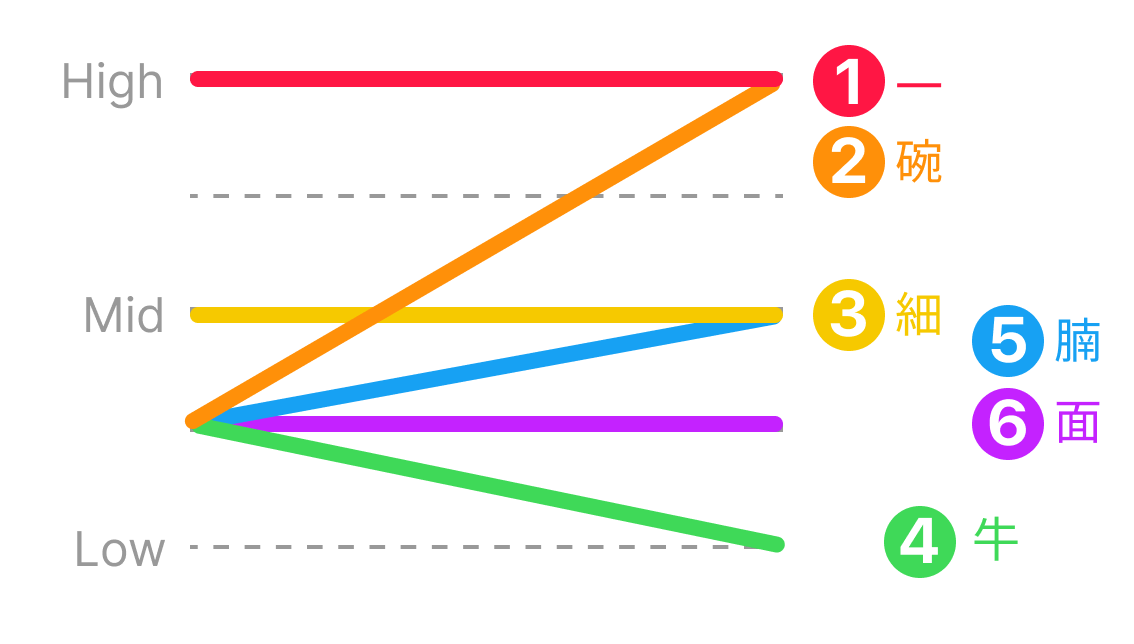
A handy phrase to remember all 6 tones:
“A small bowl of beef brisket noodles”.
一碗細牛腩麵
| jat¹ | wun² | sai³ | ngau₄ | naam₅ | min₆ |
| 一 | 碗 | 細 | 牛 | 腩 | 麵 |
| one | bowl | small | beef | brisket | noodles |
Overall
Jyutping is a powerful tool for learning to spell, type, and read Cantonese — but it's not the only option. Some learners prefer Jyutping with accent marks (diacritics) instead of tone numbers. Others find more English-friendly systems like S.L. Wong (黃錫凌), Yale, or the International Phonetic Alphabet (IPA) easier to pick up.
The best romanization system is simply the one that works for you.
At CampLingo, Jyutping is our default — but we support a wide range of Cantonese romanization systems across our tools, so you can learn your way:
- Cantonese Translator — free translations with your choice of romanization
- LingoDex — our free Cantonese learning app, built for English speakers
Give them a try today and find the Cantonese romanization that clicks for you!
🇭🇰🔤