
Learning Cantonese — one of the world's most expressive and culturally rich languages — has never been more accessible. Whether you're a complete beginner hoping to connect with family roots, planning a trip to Hong Kong, or simply fascinated by Cantonese (粵語:廣東話), there's an app (or two) that can help you get there.
This guide covers the best Cantonese learning apps available today, from flashcard-style vocabulary builders to immersive grammar courses, language exchange platforms, and TV shows. We've grouped them by type so you can find what fits your learning style.
Best Structured Cantonese Learning Apps
These apps are purpose-built to teach you Cantonese vocabulary, grammar, and listening skills in a structured way.
LingoDex (by Camp Lingo)
Best for: Immersive, grammar-focused Cantonese learning

LingoDex is a visually immersive app for learning Cantonese. Rather than relying on rote translation, it uses images to teach Cantonese words and sentences — supporting full immersion learning, where you begin thinking in Cantonese from the very start rather than translating back and forth with English.
What sets LingoDex apart is its focus on colloquial Cantonese (粵文) — the way people actually speak in Hong Kong and Cantonese-speaking communities — rather than a Mandarin approximation. It also teaches Cantonese grammar, which can differ from Mandarin grammar.
Key features:
- Immersion-based learning
- Image-based ways of learning words, grammar, and sentences
- Focuses on colloquial written Cantonese (粵文)
- Multiple romanization options: Jyutping, Yale, and IPA
- Choose your own topics
- Web app
- Freemium — free with daily lives limit
Drops
Best for: Building Vocabulary with visual cues
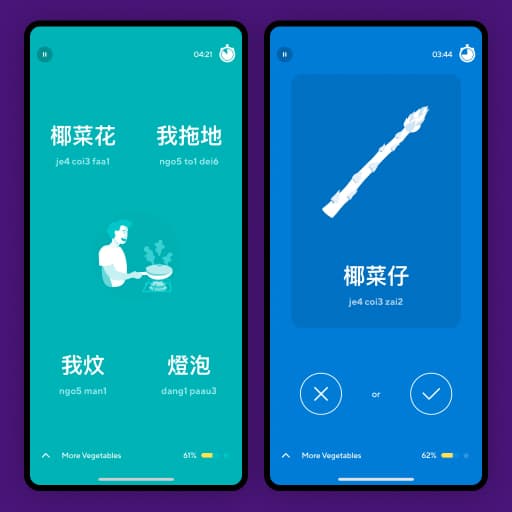
Drops is a visually engaging app that uses images and a fast-paced format to help you memorize Cantonese words. It's great for building a Cantonese word bank. It supports Jyutping romanization and lets you choose topics that match your interests.
Key features:
- Immersion-based learning
- Image-based way of learning vocabulary
- Choose your own topics
- Mainly Jyutping romanization
- Freemium — free with a daily time limit
Classic Cantonese Lessons (by Camp Lingo)
Best for: Beginners who prefer a translation-based approach
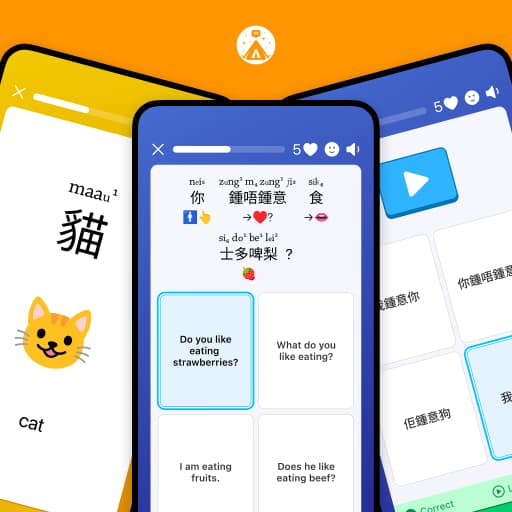
"Classic Cantonese Lessons" takes a more traditional approach compared to LingoDex. Like Duolingo, CampLingo's "Classic Cantonese Lessons" uses English translations to teach words and sentences, making it a gentler entry point for those who aren't comfortable with immersion-based learning.
Key features:
- Translation-based learning
- Translation, fill-in-the-blank (cloze deletion), and audio-to-text question types
- Audio questions for listening practice
- Multiple romanization options: Jyutping, Yale, and IPA
- Web app
- Free
Duolingo
⚠️ Not available for English speakers
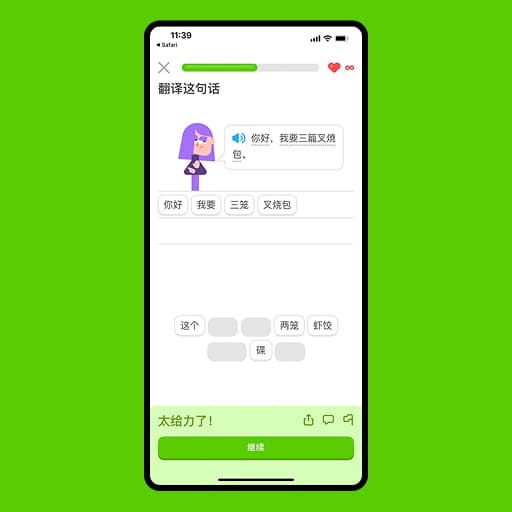
Duolingo's Cantonese course is only available to Mandarin speakers who use the Simplified Chinese Script, not English speakers. Its Cantonese course is designed for Mainland Chinese speakers, and tends to favor Mandarin grammar and Mandarin versions of words, as opposed to Hong Kong Cantonese (the most common Cantonese dialect). Suitable for those who mainly speak Mandarin (Simplified Chinese script) and can pair Duolingo with other apps to learn Cantonese words and grammar.
Key features:
- Translation-based learning
- Jyutping romanization
- Freemium — free with daily lives limit and ads
Clozemaster
Best for: Intermediate learners expanding vocabulary in context
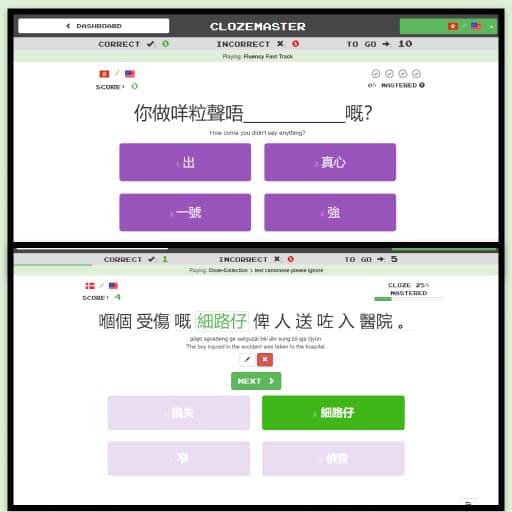
If you already have a solid Cantonese foundation and want to push further, Clozemaster is excellent. It drills vocabulary through fill-in-the-blank sentences, exposing you to words in realistic context — a great complement to more structured apps.
Key features:
- Translation-based learning
- Jyutping romanization
- Freemium — pay for advanced features
Pimsleur
Best for: Passive, audio-based learning on the go
Pimsleur's Cantonese course is audio-based, making it ideal for commuters or people who prefer learning mostly by ear. It can be quite helpful for training pronunciation. Its content is great for travel and business scenarios.
Key features:
- Translation-based learning
- Passive-based learning
- Travel and Business Topics
- $20/month
Best Cantonese Dictionary App
Pleco
Best for: Looking up words, characters, and pronunciations
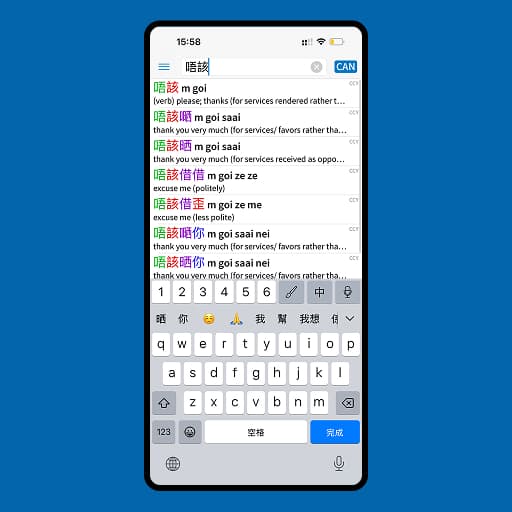
Pleco isn't a learning app in the traditional sense — it's a popular Cantonese and Chinese dictionary app, and an essential companion for any serious learner. You can enable Traditional Chinese script (used in Hong Kong and most Cantonese-speaking communities), and it supports both Jyutping and Yale romanization.
For Cantonese-specific settings, see this helpful setup guide: Pleco Cantonese Settings via CALHK
- Freemium — free with ads
Best Apps for Cantonese Tutors & Language Exchange
Sometimes the fastest way to learn is to speak with real people. Here are the best options for that.
iTalki
Best for: 1-on-1 tutoring, especially for tones
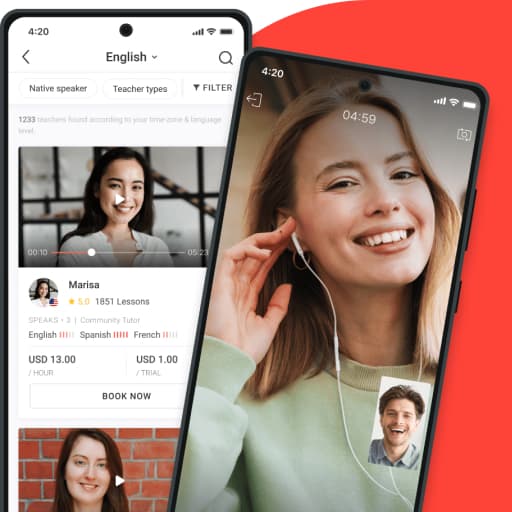
Cantonese tones (there are 6–9 depending on how you count!) are one of the biggest challenges for new learners, and nothing beats having a patient tutor give you real-time feedback. iTalki connects you with a wide range of Cantonese tutors — just be mindful of whether your tutor uses Traditional or Simplified Chinese script, and Jyutping or Yale romanization, in their materials.
- $5–$30/hour depending on the tutor
Speaking Language Exchange
Good for: Free conversation practice with native Cantonese speakers
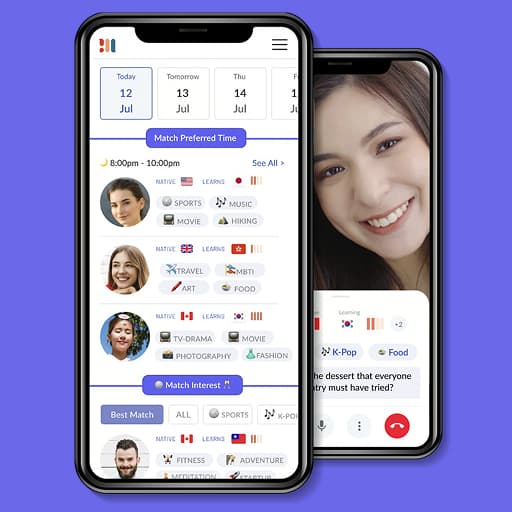
Language exchanges — where you help someone practice your language while they help you practice theirs — are one of the most enjoyable and effective ways to improve.
Speaking Language Exchange is a fairly new platform built by Cantonese speakers for Cantonese learners. It's popular among people from Hong Kong, Taiwan, and the international Cantonese diaspora worldwide.
- Free
Tandem
Best for: Feature-rich language exchange with a large community
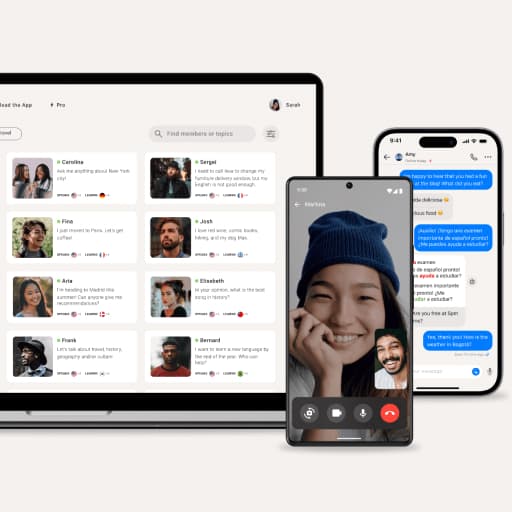
Tandem is an established language exchange app, supporting many languages – including Cantonese. Its large user base and polished features make it a reliable choice for finding conversation partners regardless of your native language.
- Freemium — free with ads
Best Cantonese Media for Learners
Cantonese Media is a great way to supplement active study. Thankfully there's a lot of Cantonese shows available:
Watching shows aimed at children is a time-honored language learning strategy: the vocabulary is simpler, speech is clearer, and visuals provide helpful context.
- Disney+ is one of the best sources of Cantonese-dubbed content, particularly in the US — many classic and new Disney films and shows are available in Cantonese.
- Apple TV has a solid selection of Cantonese content, particularly the Peanuts/Snoopy and Fraggle Rock series.
- YouTube has a growing library of Cantonese content. Search "cantonese dubs" to get started.
Additionally, despite not being an app, Story Learning's Cantonese Conversations by Olly Richards provides a collection of high quality video and audio with transcripts (Jyutping) and English translations.
Final Thoughts: The Best Cantonese Learning Setup
No single app does everything, but combining a few tools can create a powerful and enjoyable learning routine:
- Build the basics with structured, grammar-aware apps that teaches colloquial Cantonese such as LingoDex or Classic Cantonese Lessons (for a more translation-friendly start), both by Camp Lingo.
- Use a dictionary app like Pleco to look up Cantonese words in the wild.
- Enjoy Cantonese audio with formal tools like Pimsleur, or fun shows on Disney+, Apple TV, or YouTube.
- Connect with others whether with 1-on-1 tutoring on iTalki, or finding conversation partners on language exchange platforms like Speaking Language Exchange.
Today, Cantonese is easier to learn than it's ever been! The further you go, the more rewarding it becomes — connecting you with people and communities in a way only Cantonese can.
🇭🇰📱